AIxAccountancy (ISCA AI Fluency Programme): What It Is, Is It Free & Is It Worth It?
Sixty thousand accountants, one syllabus, and a badge for LinkedIn.
On 3 July 2026, ISCA and IMDA launched the AIxAccountancy programme — a free AI fluency course that aims to train 60,000 accountancy and corporate finance professionals over the next three years. If you work in finance in Singapore, someone has probably already forwarded you the announcement. Over 20,000 people registered interest before it even launched.
So what is it, actually? Is it really free, who's eligible, how do you enrol, and — the question nobody at the launch event was going to ask — what does it not do for you?
Here's the honest version.
What the AIxAccountancy programme actually is
AIxAccountancy is the first training programme under the National AI Impact Programme (NAIIP), announced in March 2026 with the goal of making 100,000 non-tech workers AI-fluent by 2029. Accountants are the first profession up. That alone tells you something about how policymakers see this industry: high exposure to AI, high volume of routine work, and a workforce that mostly hasn't been formally trained on any of it.
The structure is two progressive phases of flexible online learning, designed so you can do it around a full workload:
Phase 1: AI foundations.
Hands-on work with the general-purpose tools: ChatGPT, Claude, Copilot, Gemini. The curriculum is built around common workplace tasks — think building an AI-enabled workflow for financial statement analysis rather than abstract theory about neural networks.
Phase 2: role-specific specialisations.
This is the more interesting half. The live curriculum on AI Nexus lets you pick the specialisation most relevant to your role: AI for Tax; AI for Finance, Planning and Analysis; AI for Auditors; AI for Internal Audit and Risk; AI for Board and Governance; AI for Accounting Firms; plus a deep dive on AI concepts and workflows for enterprise use cases.
The core programme runs about 24 hours of self-paced online learning — roughly 9.5 hours of mandatory foundations, 14.5 hours in your chosen specialisation. Finish both and ISCA awards you a Certificate of Completion, CPE hours, and a verifiable digital badge you can put on LinkedIn. After that, professionals in (or gunning for) management roles can take an optional six-hour AI Leadership & Governance track on leading responsible AI adoption in their organisations, which takes the whole thing to around 30 hours.
What is AI Nexus (ISCA)?
AI Nexus is ISCA's dedicated AI platform for the accountancy profession, and it's where AIxAccountancy actually lives. If you enrol, this is the site you'll spend those 24-odd hours on: it handles registration and eligibility checks, hosts the Phase 1 and Phase 2 curriculum, and tracks your progress through both.
It's more than a course player, though. AI Nexus is positioned as a hub — a sandbox for prototyping AI-assisted workflows, a growing library of use cases contributed by firms already running this in production, and sharing sessions from practitioners and AI vendors. The Phase 2 specialisation menu is published and updated there, so the role-specific tracks can shift as the tools change.
Think of it as the profession's shared workspace for AI. The training is the entry point; the community and the use-case library are the reason to keep logging in after the badge lands.
Is the ISCA AI Fluency Programme free?
Yes — with two conditions worth reading before you get excited.
AIxAccountancy is free for ISCA members who are Singapore Citizens or Permanent Residents, including tertiary students at local institutions. No course fee, no SkillsFuture Credit to burn, no employer sponsorship to negotiate. ISCA is putting S$1 million from its AI for Accountancy Industry fund behind the programme, with IMDA backing it under the National AI Impact Programme.
The two conditions are the membership and the residency. If you're a finance professional here on an Employment Pass, or you've simply never taken up ISCA membership, the fee waiver isn't aimed at you — worth checking before you plan your CPE year around it.
The broader push covers professionals working in accounting and finance roles across the public and private sectors; the Accountant-General's Department is already planning to put all 4,000 public sector finance and internal audit officers through it.
Enrolling is straightforward: register on AI Nexus with your ISCA membership details, submit the documentation ISCA asks for to confirm eligibility and the fee waiver, and start Phase 1 whenever you like. Phase 2 unlocks once foundations are done.
If you're eligible, the price argument is over before it starts. Free, self-paced, CPE hours attached. There is no version of this where doing nothing is the smarter move.
Why this matters more than the usual CPD circular
Two details make this more than another training announcement.
First, ACRA's refreshed Skills Framework for Accountancy now embeds AI fluency across all 44 accountancy job roles. Not "data analyst" roles. All of them. AI fluency is being written into the definition of what an accountant is, the same way Excel competence became non-negotiable a generation ago.
Second, the framing from the top. ISCA president Lee Boon Teck put it this way: the professionals who thrive will be "AI bilingual" — deep accounting expertise combined with the ability to use AI confidently, responsibly, and with sound professional judgement. That word bilingual is doing real work. It's not "AI will do accounting." It's "accountants who speak AI will outcompete accountants who don't."
We made a similar argument back in December, before any of this was announced: AI won't take your finance job, but someone who leverages AI better than you might. It's mildly surreal watching that thesis become national policy.
The honest take: what a fluency course can't fix
Now the part the press release won't tell you.
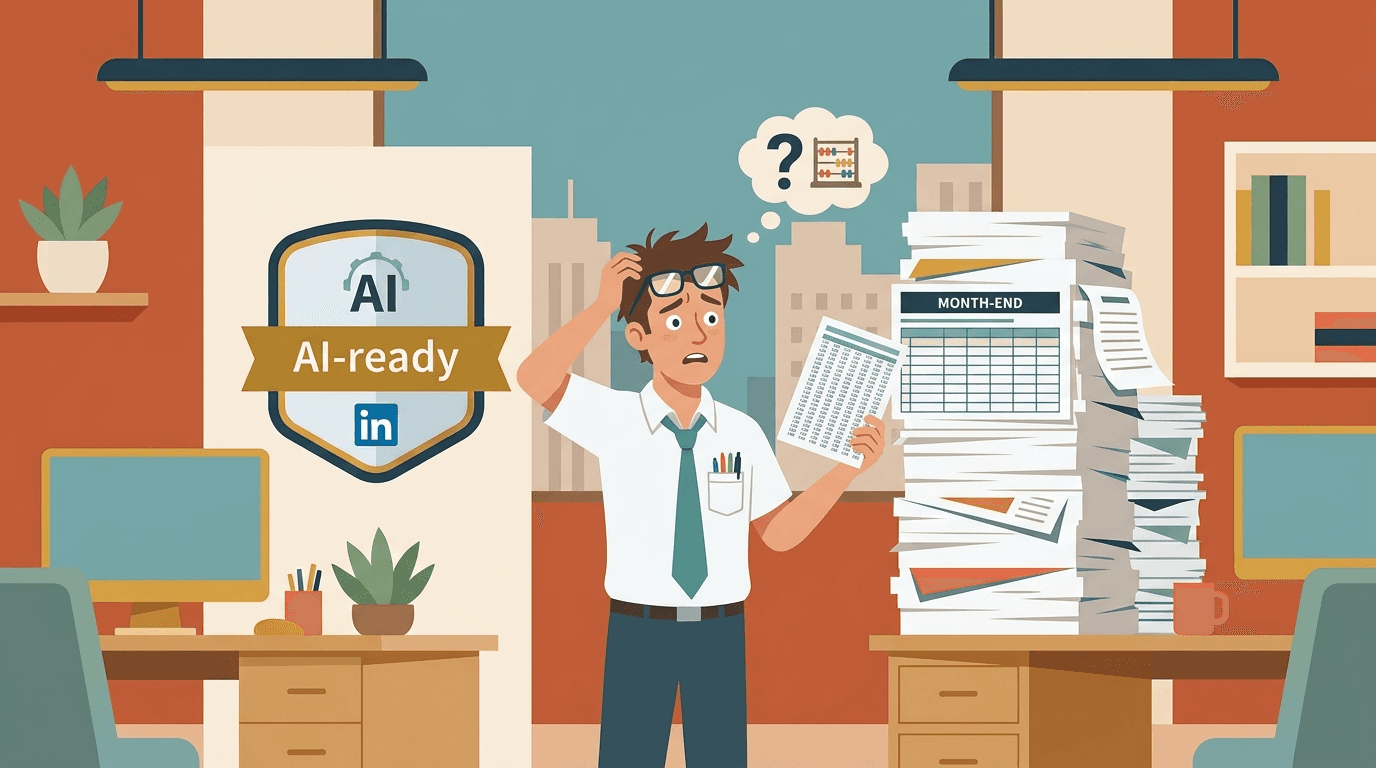
AIxAccountancy teaches fluency — how to use AI tools well. That's genuinely valuable, and you should do it. But fluency is not the same thing as fixing your workflows, and it's worth being clear-eyed about the difference before you finish Phase 2 expecting your month-end to feel different.
A fluency course teaches you to prompt ChatGPT to summarise a financial statement. It doesn't restructure the process where three staff spend the first week of every month rebuilding the same management accounts in Excel because the reports your clients need don't exist in Xero.
It teaches you what an AI-enabled workflow looks like in a sandbox. It doesn't map your firm's actual reporting stack — the specific ledgers, the intercompany quirks, the layouts your clients have been trained to expect — into something automated and repeatable. That's not a skills problem. It's a systems problem, and no amount of prompting technique makes a broken process worth speeding up.
The risk with any fluency programme is that people come out of it doing the old workflow slightly faster — using Copilot to write the email around the spreadsheet, rather than asking why the spreadsheet exists at all. The badge proves you can use the tools. It doesn't prove your firm's work has changed.
None of this is a knock on the programme. It's a statement of scope. ISCA is handing the profession the vocabulary; what you build sentences about is up to you.
So is AIxAccountancy worth it?
If you're eligible: enrol. It's free, it's CPE, and within a couple of years "AI bilingual" will be an assumption in hiring conversations, not a differentiator.
But treat the course as the starting line. While you're going through Phase 1, keep a running list of every task in your week that feels like "work before the real work" — the recurring reports, the copy-paste consolidations, the formatting rituals. That list is worth more than the certificate, because it's the map of what should be automated in your practice, not the syllabus's.
And when you hit the items on that list that a chatbot can't fix — the custom Xero reports, the multi-entity packs, the layouts that have to look exactly the way your clients expect — that's the gap between AI fluency and AI leverage. It's the gap Cheetah lives in, if you ever want help crossing it.
Course first. Then the real work.
Frequently asked questions
- What is AIxAccountancy?
- AIxAccountancy is a free AI fluency programme launched by ISCA and IMDA on 3 July 2026, with the goal of making 60,000 accountancy and corporate finance professionals in Singapore AI-ready within three years. It is the first non-tech cohort under the National AI Impact Programme. The programme runs as two phases of self-paced online learning: foundations with general-purpose tools like ChatGPT, Claude, Copilot and Gemini, then a role-specific specialisation such as AI for Tax, AI for Auditors, or AI for Finance, Planning and Analysis. Finish both phases and ISCA awards a Certificate of Completion, CPE hours, and a verifiable digital badge.
- Is the ISCA AI Fluency Programme free?
- Yes. AIxAccountancy is free for ISCA members who are Singapore Citizens or Permanent Residents, including tertiary students at local institutions. There is no course fee, and you do not need to spend SkillsFuture Credit on it. ISCA is funding the programme with S$1 million from its AI for Accountancy Industry fund, with IMDA support under the National AI Impact Programme. The two conditions that matter are ISCA membership and Singapore Citizen or PR status — if you do not meet both, the fee waiver does not apply to you.
- Who is eligible for AIxAccountancy?
- The free tier covers ISCA members who are Singapore Citizens or Permanent Residents, including tertiary students at local institutions. The broader programme targets professionals in accounting and corporate finance roles across both the public and private sectors — the Accountant-General's Department is putting all 4,000 of its public sector finance and internal audit officers through it. Foreign professionals working in Singapore finance roles without ISCA membership are the main group left outside the free tier.
- How do I enrol in AIxAccountancy?
- Enrolment runs through AI Nexus at ainexus.isca.org.sg. You register with your ISCA membership details, submit the documentation ISCA asks for so it can confirm your eligibility and fee waiver, then start Phase 1 at your own pace. Phase 2 opens once foundations are done, and you choose the specialisation that matches your role. After both phases, professionals in or moving towards management roles can add the optional AI Leadership and Governance modules.
- What is AI Nexus (ISCA)?
- AI Nexus is ISCA's dedicated AI platform for the accountancy profession, and the site where AIxAccountancy is delivered. It hosts enrolment, the Phase 1 and Phase 2 curriculum, and your progress through both. Beyond the course itself it functions as a hub: a sandbox for prototyping AI-assisted workflows, a library of use cases contributed by firms already running AI in production, and sharing sessions from practitioners and AI vendors. The Phase 2 specialisation menu is published and updated there, so the role-specific tracks can change as the tools do.

A finance professional turned product builder, Jarvin has built hundreds of reports by hand and knows what financial and operational reporting demands: customisability, auditability, scalability, and security. Having automated that work reliably, he's now helping advisory firms and finance teams do the same.
