
Is AI Really Taking Away My Finance Job?
The question that's been silently on our minds since ChatGPT's release
As an early adopter of Gen AI tools, I've been blown away by how good they are. From mere rule-based automation to dynamic systems that pick up on nuances and subtleties, they've gotten so good to the point they're beating us humans at some tasks.
If you're like me, that might be giving you a sense of anxiety. How do we finance folks keep ourselves relevant in the age of AI? Do we even still have a place in a future where these systems are so capable?
State of AI Today
When discussing AI, it's important to know where we're at today. As of early December 2025, three years after the launch of ChatGPT, we've seen AI predominantly used in these areas of finance:
Bookkeeping & Closing
- Automatically categorising transactions
- Detect anomalies, miscoding and mistagging
- Document data extraction and parsing
Vendor/Customer Management
- Duplicate payment prevention and identification
- Contract analysis and risk scoring
- Payment collection follow-ups and reminders
FP&A
- Forecast revenue and cash flow based on historic patterns
- Generate basic narratives and explaining variances
- Conversational finance assistants with payments/banking/accounting data as knowledge base
Investment Analysis
- Document data extraction and report summarisation
- Basic due diligence background research
- Thought partner in crafting narratives and preparing decks
Many of these are limited to point task for now. But not for long...
Trajectory of AI in Finance
These use cases will only get better as the models behind them improve and become more affordable. This also makes it possible for software to solve many of these use cases collectively to tackle entire horizontal chunks of the value chain in an AI-native way:
- Tofu: AI agent that handle the end-to-end bookkeeping for businesses
- Jaz: Accounting software that automatically handles most of the pre-close automation use cases and reporting features
What's becoming obvious is if your job scope only involves completing tasks that don't require much judgement, AI is coming for you.
Where AI Has Never Been
I threw an annual report of a company I was looking to invest in into ChatGPT and Gemini last week (on a personal basis – not investment advice!). Here are excerpts of what I got:
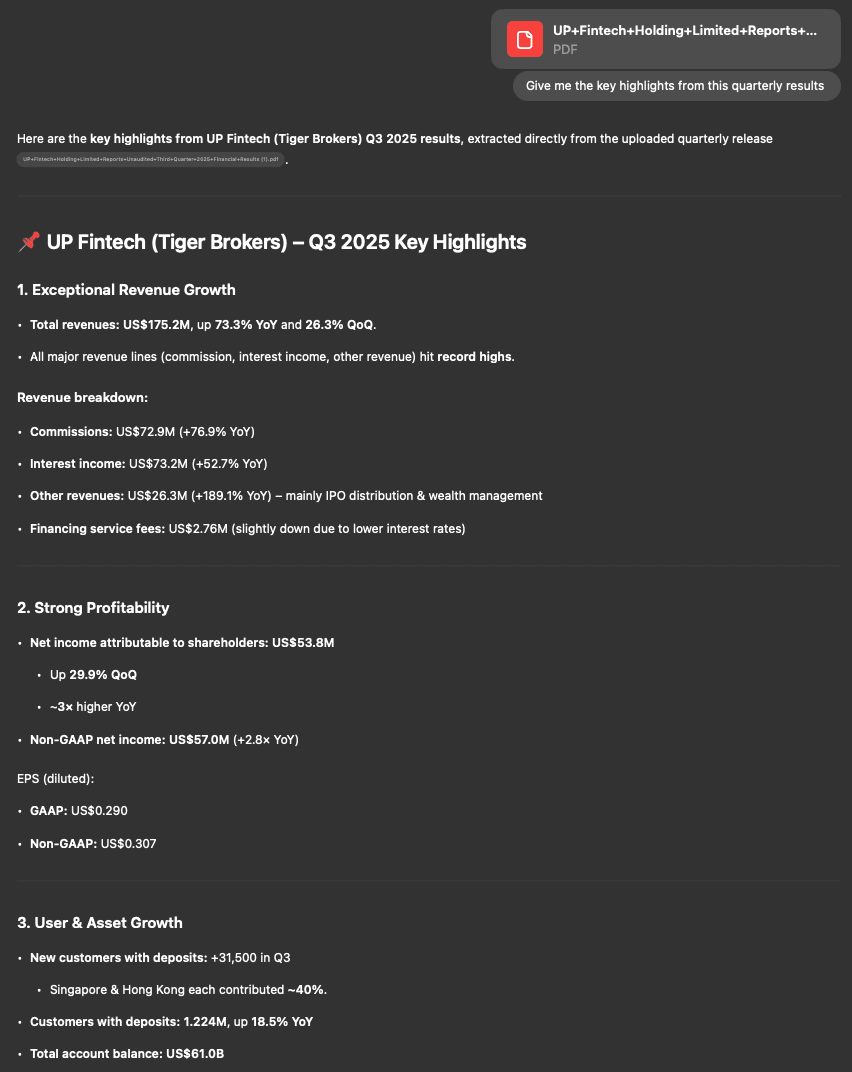
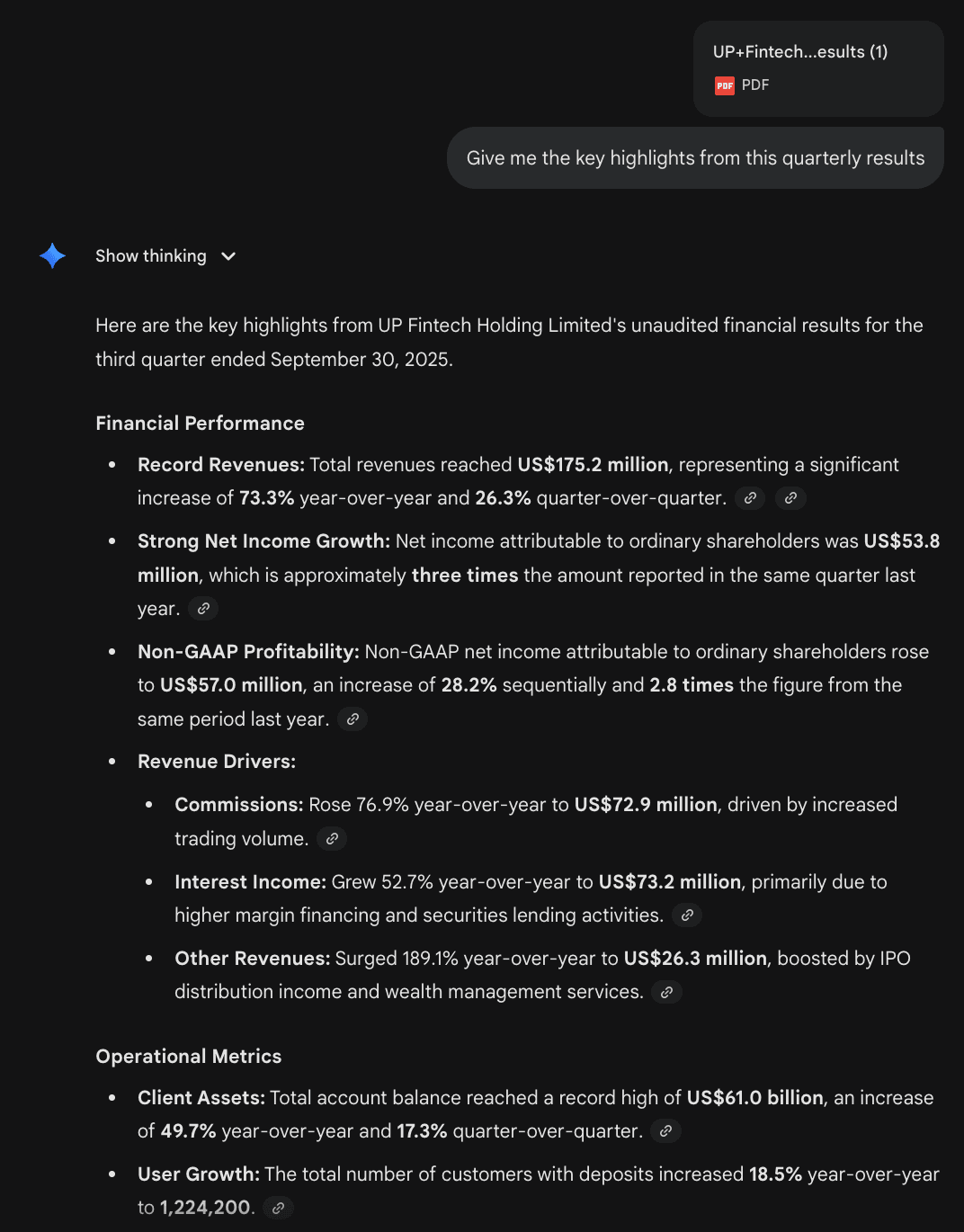
This looks great at first glance – it seems to highlight the most noteworthy points of the report. But are these the most important things to look at? Or are these the points that the management would like investors to focus on. I sat down to think from first principles and these are questions I had for myself:
What are the key metrics that we should actually care about that would represent "investability"?
Given the recent volatility, should we treat every dollar of revenue across the different revenue segment the same?
What are some metrics that look good here but may not paint the full picture?
Given this company is an online brokerage platform, it became clear that I should:
- Not be too fixated on near-term financial metrics that are highly influenced by external factors, i.e. higher interest income when interest rates are rising doesn't mean much.
- Adjust performance for the economic environment, i.e. higher account balance should be adjusted for rise in overall equities and mark-to-market gains to gauge true inflows.
- Focus on key truthy operating metrics as they are the earliest predictors of revenue slowdown. These metrics are not immediately obvious and requires staring at the P&L with curiosity to figure out what are the follow-up questions you'd want answers to:
- Increasing user count is good, but is this at the cost of higher marginal marketing spend? → Track Marketing expense per Newly added user
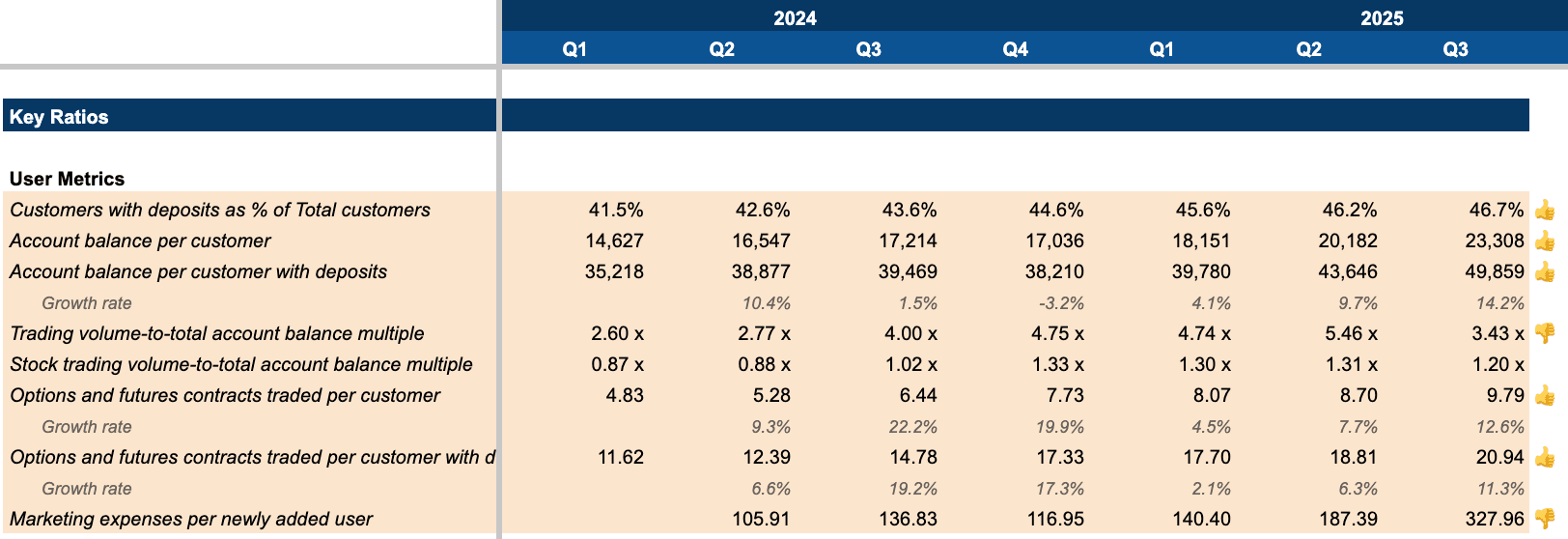
- Do the new customers actually deposit funds or are we wasting resources supporting phantom accounts? → Track Customer with deposits as a percentage of Total customers
- Is the increase in commission revenue supporting margin expansion? → Track Execution & clearing expenses as % of Commission income
What we want is a report structure that would achieve these and shed light on the questions earlier. And this was what I came up with:
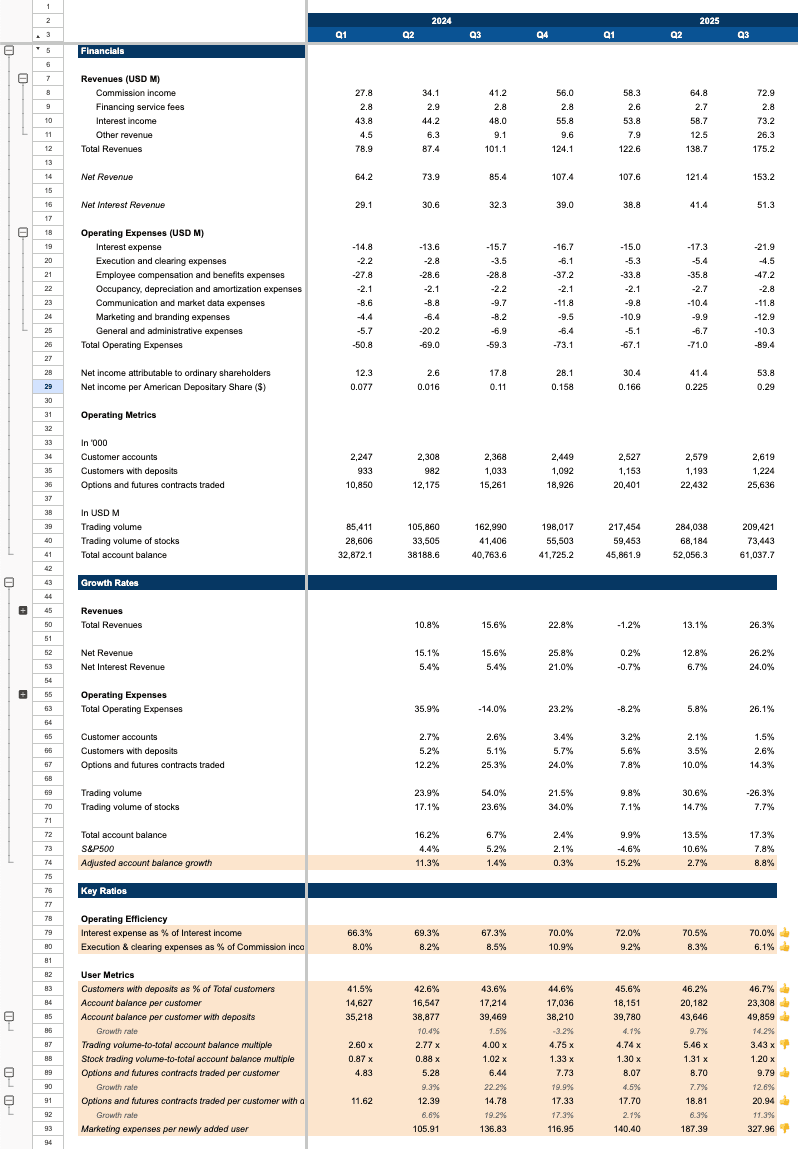 Tigr Model
The numbers are populated by Gemini and ChatGPT, by pointing them to the list of quarterly results from UP Fintech's Investor Relations page. Yes, I pitched them against each other because I was not ready to base my investment decisions on their potential mistake (and yes, I did spot some!).
Granted, it's not a rigorous DCF model but valuation is not the focus here. The point is to confirm or invalidate the thesis that the company is still growing sustainably.
Now it's clear from here that:
- There's healthy growth across all revenue segments. Investigating deeper, the huge 110% sequential increase in Other Revenue is caused by increasing traction in its IPO underwriting business. This is consistent with the tailwind from the pickup in M&A activities.
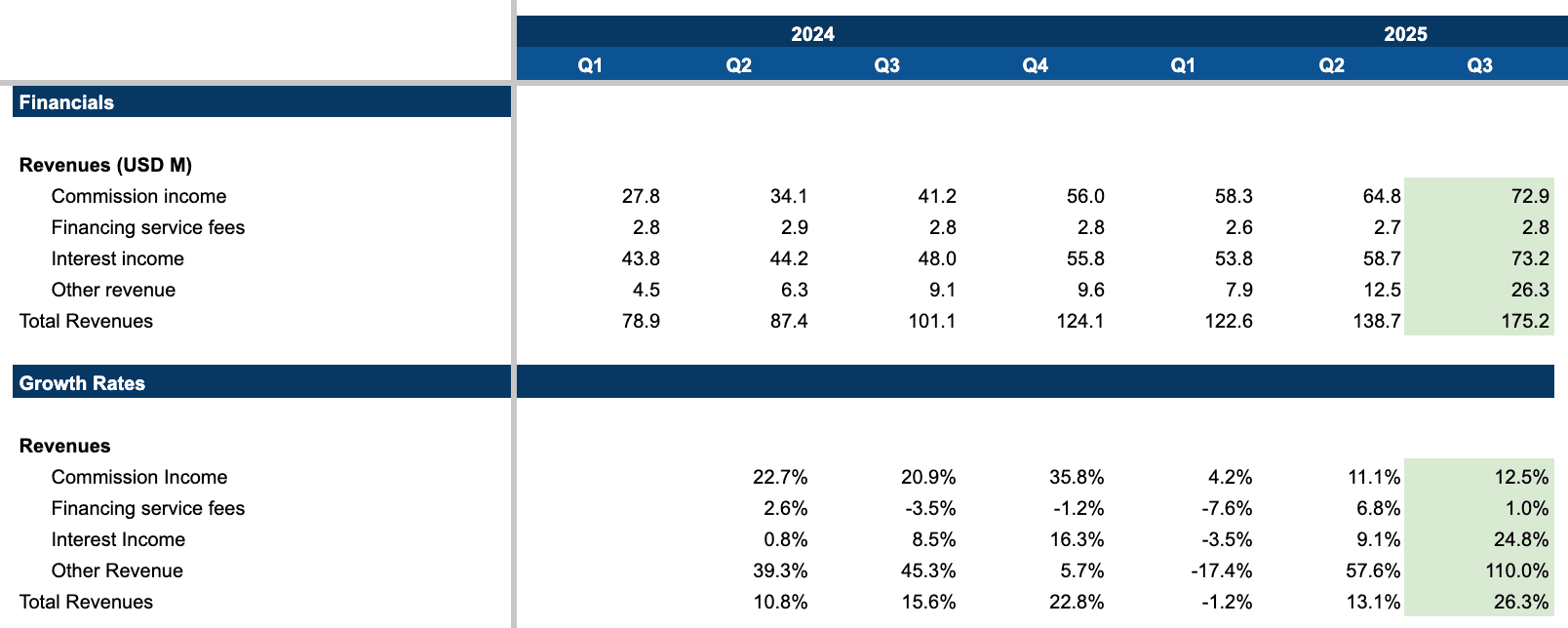
- The growth in Commission income and Interest income is sustainable, i.e. they are supported by healthy margins where their corresponding operating expense is growing at similar rates or below that of income.
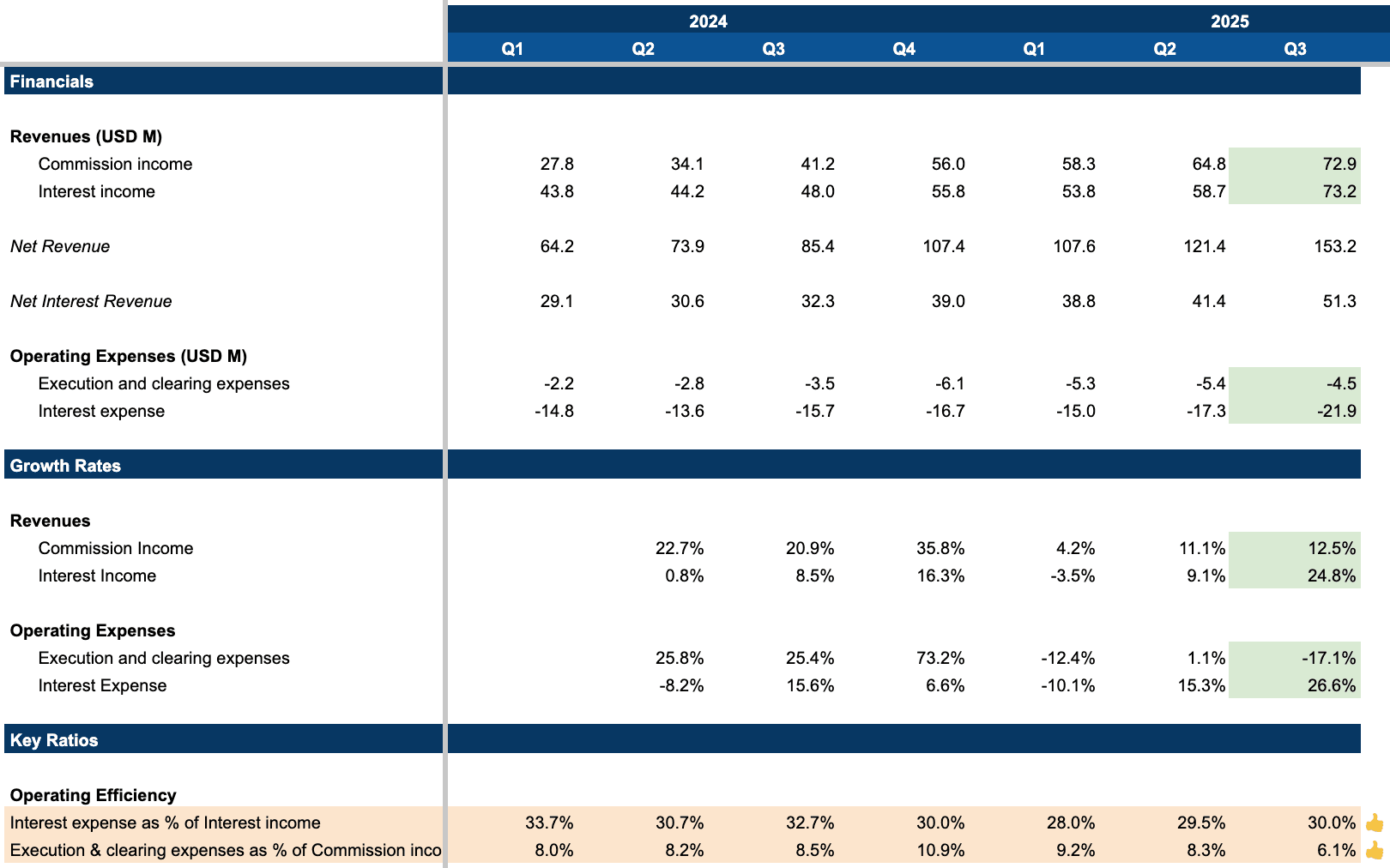 UP Fintech Commission and Interest Margins
- Account balances are growing at a healthy rate, even after adjusting for overall mark-to-market gains.
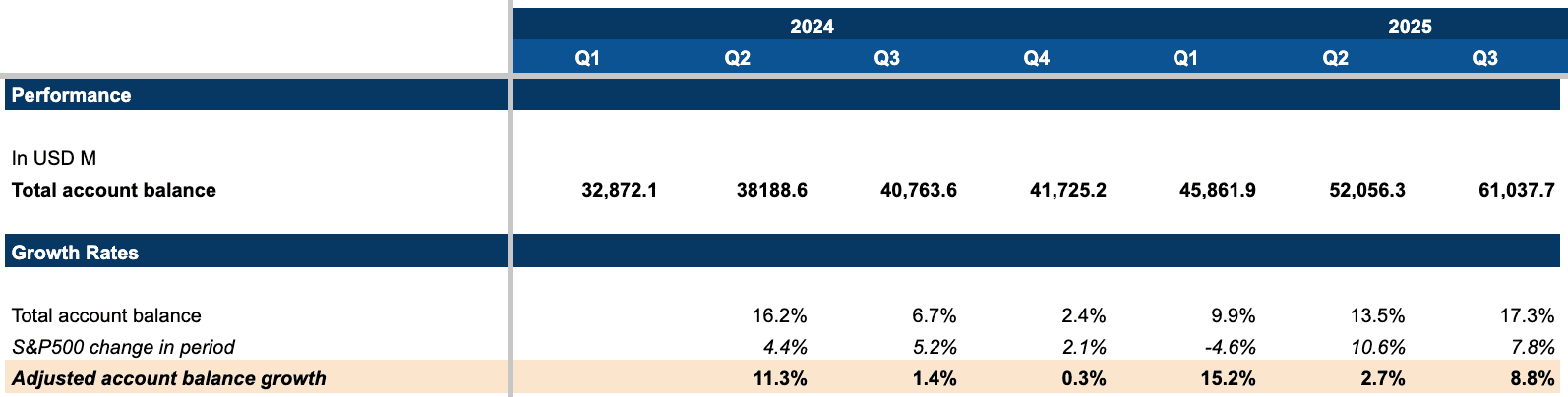 UP Fintech Account Balance
4. Sequential customer growth appears to be slowing from the consistent 2-4% down to 1.5%. We see the same pattern in customer with deposits (5.x% down to 3.5% in Q2, and 2.6% last quarter). This is concerning considering that it is happening against the backdrop of higher marketing spend (31% increase sequentially and 57% increase YoY).
UP Fintech Account Balance
4. Sequential customer growth appears to be slowing from the consistent 2-4% down to 1.5%. We see the same pattern in customer with deposits (5.x% down to 3.5% in Q2, and 2.6% last quarter). This is concerning considering that it is happening against the backdrop of higher marketing spend (31% increase sequentially and 57% increase YoY).
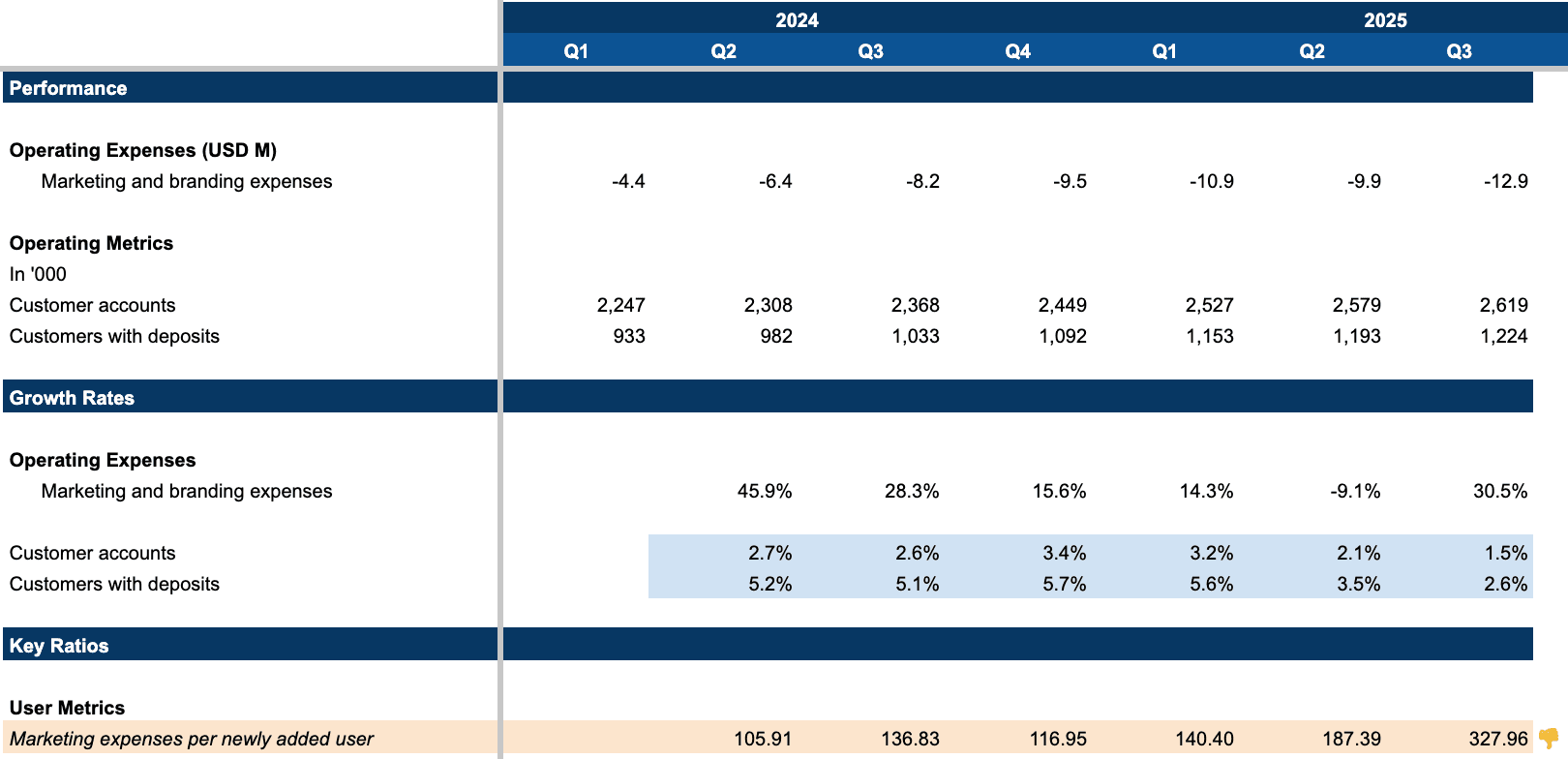 UP Fintech Customer Growth
- It can be argued that while marketing efforts do not show up well in the number of new users, it is positively affecting the quality of users brought on the platform:
- The proportion of meaningful accounts has been steadily increasing (customers with deposits as a percentage of total customers)
- The number of options and futures contracts traded per customer has also been increasing healthily at low double-digits percentage sequential growth
- Trading volume relative to account balance has also slowed down significantly, likely attributable to the hangover from the AI trade as investors on the platform are spooked by increasing capex and circular deals increasingly reported in the space.
This is highly opinionated thinking and analysis beyond what AI is capable of today. In a world where unopinionated safe answers is increasingly commoditised by AI, the value is clearly in asking the right questions and having bold high-conviction takes on how we want to answer them. There's no substitute for thinking. It means going beyond completing tasks and answering question – to figure out what tasks are worth doing in the first place and structure them in a way that allows us to harness AI for efficiency.
Task Factory → Question Asker
It is a fundamental mindset shift – from clearing to-do lists to creating them. That is exactly the whole purpose of knowledge work. Somewhere along the way, software has become so rigid that we've gotten used to fitting the way we work to them. Job scopes become software-specific tasks. We become cogs in a machine fulfilling them. Thankfully, AI is changing that.
Knowing what reports to create, how to deal with seasonality, what key metrics should be in these reports, analysing these reports well to derive insights, predicting what questions your manager would ask, contextualising them to operational realities, creating actionable next steps, getting leadership buy-in, and motivating teams to take action are the true value of what we finance folks bring to the table.
Bandwidth to Ask Questions
It's hard to be asking questions when we're already struggling with answering those asked by our managers. That is why it's important to automate anything that can be automated. Your job wouldn't be replaced by AI (at least not yet), but it'll be replaced by someone who knows how to leverage AI in a way that makes them feel impossibly productive. This means if you're spending hours every week building the same reports and not thinking about the right questions to be asking, you're positioning yourself to be replaced.
Creating manual reports is just work before the real work – something that can and should be automated away. Because frankly, other than the intellectual challenge of building it the first time, it's a rather mundane and repetitive process.
That is why I'm dedicating my career to automating away manual reports – so we can focus on higher-value thinking work that actually drives businesses forward. Strategising, contextualising and communicating – these are things AI won't be touching anytime soon and where we should spend our brainpower and time on.
If you want to reclaim your time from low-value manual work, we should chat!

A finance professional turned product builder, Jarvin has built hundreds of reports by hand and knows what financial and operational reporting demands: customisability, auditability, scalability, and security. Having automated that work reliably, he's now helping advisory firms and finance teams do the same.
