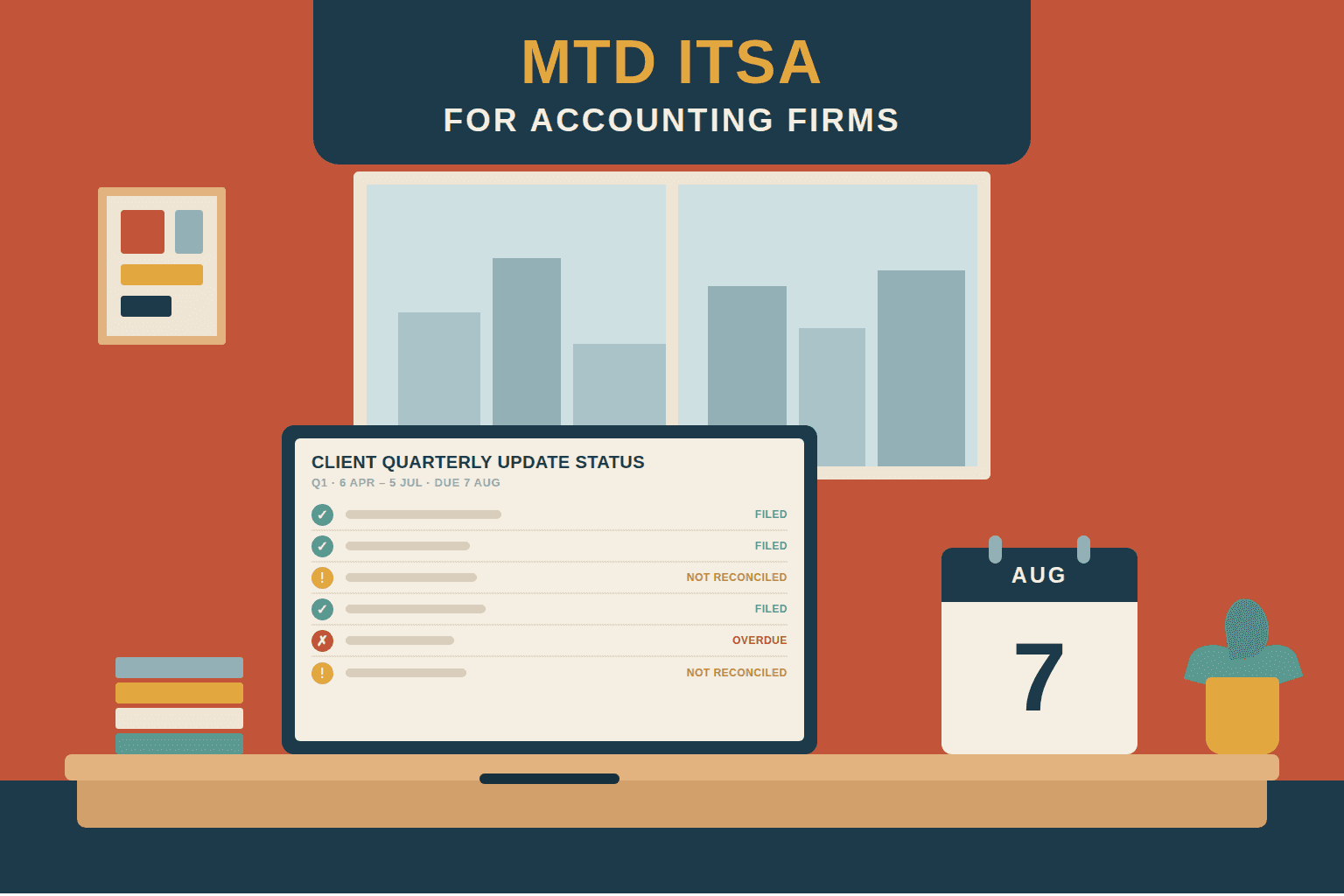
MTD ITSA for Accounting Firms: Why Xero Can't Tell You Which Clients Are Behind
864,000 people were due to file their first quarterly update. Somewhere, a spreadsheet is tracking all of them.
7 August 2026 came and went. If you run an accounting practice with sole trader or landlord clients earning over £50,000, that date was the first quarterly update deadline under Making Tax Digital for Income Tax (MTD ITSA) — the first time HMRC has asked roughly 864,000 taxpayers to report income and expenses four times a year instead of once.
HMRC called it "a landmark moment for the tax system." For most firms, it was three weeks of a different kind of landmark: chasing bank feeds, reconciling half-finished ledgers, and trying to answer one deceptively hard question — which clients have actually submitted, and which haven't?
The quarter just got four times busier
Before MTD ITSA, a sole trader or landlord client meant one Self Assessment deadline a year: 31 January. Now, for anyone over the threshold, that's four quarterly updates plus a final declaration — five filing events instead of one, each with its own 7th-of-the-month deadline:
- Q1 (6 April – 5 July): filed by 7 August
- Q2 (6 July – 5 October): due 7 November
- Q3 (6 October – 5 January): due 7 February
- Q4 (6 January – 5 April): due 7 May
- Final declaration: due the following 31 January
(Clients can elect to report on calendar quarters — 1 April to 30 June and so on — instead of tax-year quarters. The deadlines don't move.)
A firm with 150 MTD-in-scope clients isn't tracking 150 deadlines a year anymore. It's tracking 750. And the client list is about to grow a lot faster than headcount will: the qualifying income threshold drops to £30,000 in April 2027, then £20,000 in April 2028. HMRC's own estimate is that up to 3 million taxpayers will eventually be in scope — more than three times the current 864,000.
Xero doesn't have a client-wide view yet — even Xero says so
Here's the part that catches firms out: Xero handles the quarterly submission itself reasonably well at the individual client level. What it doesn't give you is a single screen showing submission status across your whole MTD client base — who's filed, who's overdue, whose ledger isn't even reconciled enough to file yet.
That's not a dig — it's what Xero's own product team has said. In their August 2026 update on managing UK clients, Xero confirmed they're "continuing to develop" their MTD ITSA solution for practices, and separately laid out a roadmap of practice-wide visibility improvements — like client group visibility across Xero HQ and Xero Practice Manager, and better data flow between Xero HQ, XPM and Xero Tax — described as coming "in the months ahead," with no firm launch date. Xero HQ and XPM are built for job and task tracking in general — they weren't built around the specific rhythm of four HMRC deadlines a year per client.
So for now, practice-wide visibility has to come from somewhere other than Xero itself.
Where the real risk sits
It isn't the penalties. HMRC isn't issuing penalty points for late quarterly updates in a business's first 12 months in MTD, and even after that it's one point per missed deadline with a £200 fixed penalty only at four points in a rolling two years. Quarterly updates are also cumulative and correctable — a figure that was wrong in Q1 gets fixed in Q2's year-to-date numbers, not in a penalty letter.
The real risk is capacity. Five filing events per client turns the January crunch into a year-round triage problem, and the firms that struggle won't be the ones that picked up a penalty point — they'll be the ones that couldn't see which 30 of their 150 clients needed chasing this week. A missed deadline is usually a symptom of that: nobody knew the file wasn't quarter-ready — unreconciled transactions, uncategorised expenses, a bank feed that stopped syncing three weeks ago — until the 7th was already close.
The tooling that exists answers a different question. Tax suites like IRIS, TaxCalc, Digita and Sage for Accountants, and HMRC's own Agent Services Account, can show you submission status — which quarterly updates have been filed with HMRC and which haven't. What none of them show is ledger readiness — whether each client's books are reconciled and clean enough for that quarter to be filed at all. Submission status tells you what happened. Readiness tells you what's about to.
Where a consolidated view actually helps
Readiness is the side of that line Cheetah sits on. Cheetah connects to every client's Xero organisation and builds reports that pull across all of them at once — so a firm-wide readiness report can flag, for each in-scope client, whether the quarter's bank feeds have been reconciled, whether transactions are still sitting uncategorised, and whether anything has moved in a period that's already been filed. That's the list of who needs chasing this week, in one place, with time left before the 7th.
To be clear, Cheetah is not an HMRC filing tool. It won't submit the quarterly update, and it won't show you HMRC's receipt status — your tax suite or the Agent Services Account already does that. What it answers is the question those tools can't: across your whole MTD client base, which ledgers are actually ready to file. If that's still something your team works out client by client, Cheetah is worth a look before the November deadline — and worth having in place before the £30,000 threshold expands your MTD client list next April.

A finance professional turned product builder, Jarvin has built hundreds of reports by hand and knows what financial and operational reporting demands: customisability, auditability, scalability, and security. Having automated that work reliably, he's now helping advisory firms and finance teams do the same.
