What I Learnt Building 100+ Reports by Hand
Spoiler: They should just all be automated
After building hundreds of finance reports manually over the course of my career – depreciation schedules, quality of earnings, multi-entity P&Ls, AR ageings, you name it – I’ve realised something important:
Numbers don’t break. But reports do – because we design them like archaeological ruins, layer after layer of fixes.
If you’ve ever inherited a spreadsheet and immediately whispered “what on earth is this,” this one’s for you.
Different Reports, Same Mistakes
Every report has its quirks. Even reports with the same name across different companies carry different nuances, data, visualisations, and expectations. While they can be vastly different, the same mistakes appear again and again:
- Numbers with zero context — so nobody trusts them enough to make decisions.
- Formula spaghetti that forces every analyst into Excel forensics.
- Cells that look useless but secretly prevent the whole thing from exploding.
- Hardcoded values that should be dynamic but aren’t.
- Workflows built around specific humans instead of systems.
Fortunately, these mistakes can be fixed. We just need to rethink what reports are and what they're meant to do.
Good Reports Tell Stories
The best reports I've seen make it immediately obvious what's going on. Beyond that, they make it easy to know the story behind the story:
| A good report says... | A great report says that and... |
|---|---|
| (1) Recent month's cash burn is 18% more than last 12 months' average. | Such burn is not sustainable and the company will need to raise funds within 7 months, 4 months **earlier than previously forecasted. ** |
| (2) Product revenue leapt from $146k to $257k. | This is due to blockbuster gains in sales from the QuantumQuake Home Theatre and HyperTech VR Headset. There's no material change to the other products. |
| (3) Huge 30% spike in Operating Expense is caused by a marketing campaign. | Most of this increase is attributable to an increase in marketing cost, particularly because of two specific invoices paid to Influencers A and B. |
Without resorting to this many words, great reports make these points obvious through cleverly-picked datapoints, visuals and structure. Trends are depicted through cleanly-labelled tables and trendlines; distributions through pie charts, segmented bar charts; constituent datapoints easily accessible through drill-downs, etc.
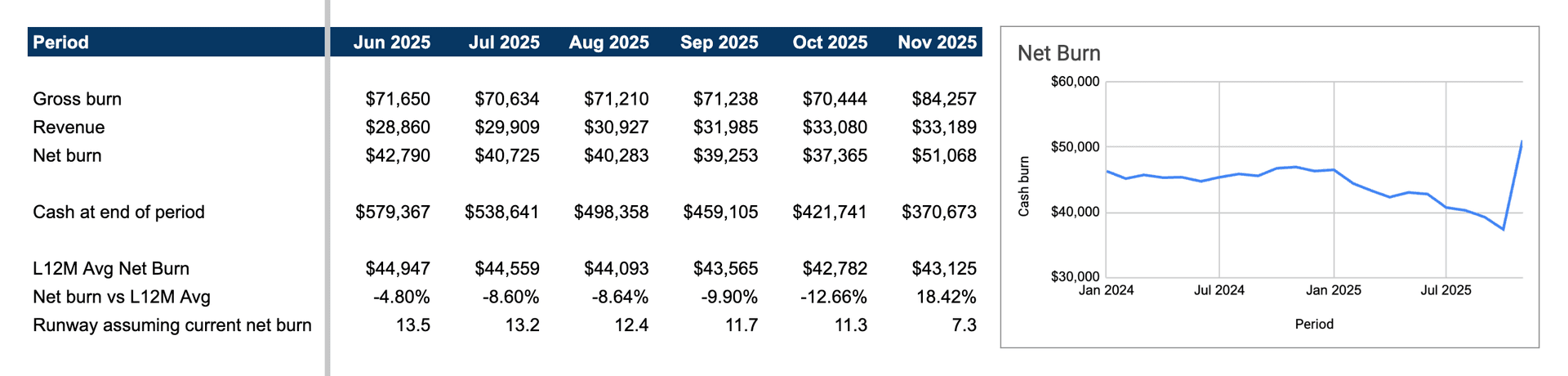 Net Burn
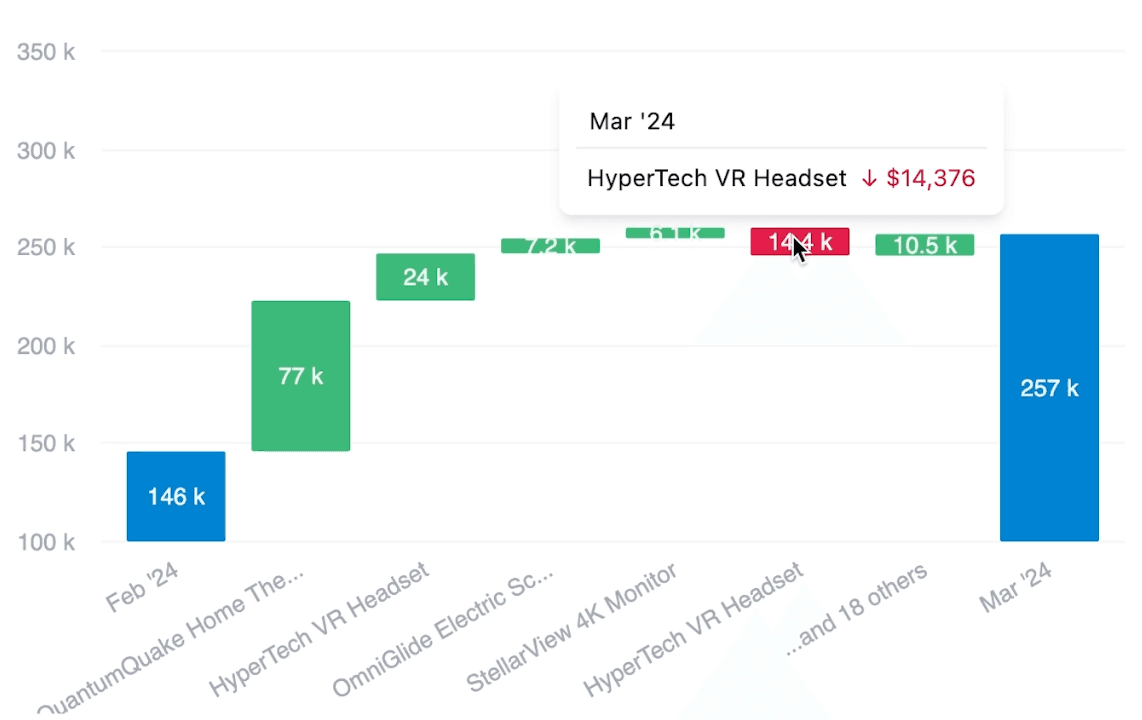 Zebra Waterfall
Telling The Right Story
Just as important as telling a story is making sure the story you're telling is the correct one. It's often not straightforward how business logic should be applied when transforming data – sequence of transformation, resolution of aggregated data, changing data in situ vs restating them at different stages of data transformation, etc.
It is crucial that business logic is applied systematically, following a thoughtful sequence of data transformation, in a way that remains auditable. This means making the intermittent statuses of the data clear so none of the business logic is missed or applied twice.
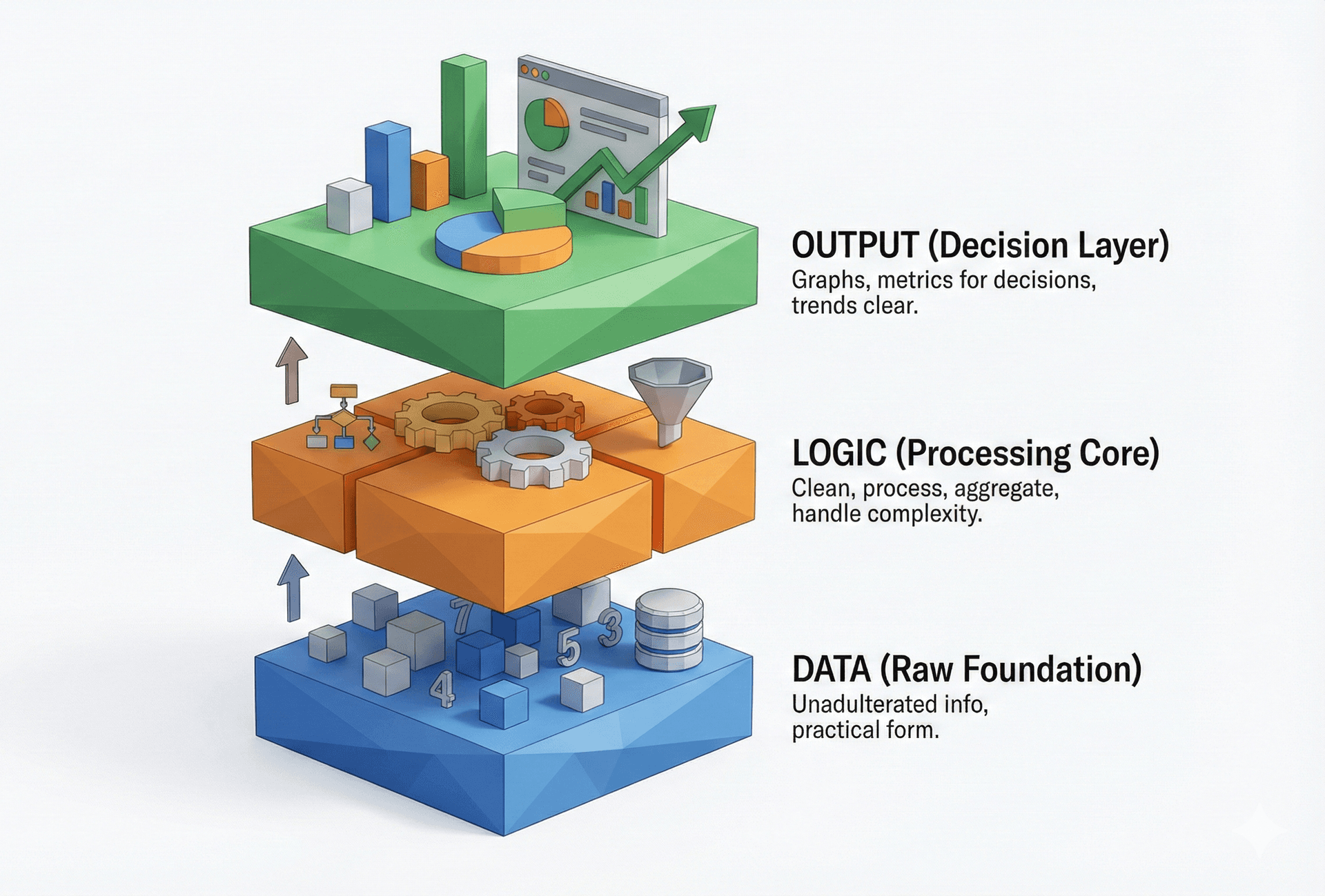
To achieve that, a report should essentially have three clean layers:
Data: Information in the rawest form that is practical. It should serve as the main source of truth and remain unadulterated – any adjustment should sit systematically within the logic layer referencing this data.
Logic: How the data is cleaned, processed, aggregated, reformulated to make sense for the eventual output. Depending on the complexity of the report, there could be multiple layers of logic to handle different business requirements.
Output: The graphs, charts, tables, metrics that readers will be using to make decisions. It should contain the most salient datapoints and any historic trends and variances should be made clear in the choice of visuals here.
Clarity > Complexity
Reports tend to grow messier over time. Extra metrics sneak in, stray tables and cells appear, and before long the original purpose gets buried under layers of scope creep.
The fix isn't to keep adding tables and cells. If new information is genuinely needed for decision-making, it should be properly systemised with clear logic layers or spun off into a separate report altogether. No more orphaned tables, mysterious helper cells, or half-explained workarounds.
A report that does one thing exceptionally well will always outperform one that tries to do a dozen things poorly. Clarity wins.
The Best Reports Survive Employee Turnover
Anyone can build a report that works for themselves.
But a great report is one that someone else can understand, maintain, and fix under pressure. If your report needs a 12-minute guided tour to explain where everything lives… it’s not a report. It’s a hostage situation.
A finance reporting workflow isn’t successful when the builder understands it. It’s successful when it can survive turnover of teams. Effortless to create. Foolproof to interpret.
"If it's always the same, why not just automate it"
That's good instinct. But anyone who's tried automating complex business processes would know it's not trivial. You'd imagine building once and using it in perpetuity. In reality, we trip over:
- Designing logic robust enough that doesn't rely on human spotting anomalous needles in haystacks
- Systemising business logic, especially those that cannot be captured in a single GSheet or Excel formula
- Automating the messiest 20% of edge cases that would take 80% of effort
That's not to say it should not be automated. It just isn't as trivial as you might think. When manual processes are broken or has not been formalised, automating them just breaks things further.
Enter Cheetah
Most reports don’t fail because someone typed a number wrong. They fail because they rely on invisible rules, heroic memory, and that one person who “knows where the bodies are buried.”
This is why Cheetah exists – so your reports don't need heroes. Cheetah automates the most complex reports you build by hand, while keeping to the highest standards of data cleanliness, professional formatting and auditability.
Building reports is just the work before the actual work. The real work is in analysing these reports and acting on insights and opportunities. If you're drowning in messy spreadsheets or want to rethink your finance workflows, let's have a chat.

A finance professional turned product builder, Jarvin has built hundreds of reports by hand and knows what financial and operational reporting demands: customisability, auditability, scalability, and security. Having automated that work reliably, he's now helping advisory firms and finance teams do the same.
