Free AI Courses for Accountants in Singapore in 2026, Compared
A quick overview of upskilling options for accountants in 2026
If you're an accountant in Singapore right now, your inbox is probably full of AI training offers. ISCA launched a free programme this month. SkillsFuture has a growing shelf of subsidised courses. Every training vendor in the country has bolted "for Accountants" onto a prompt-engineering workshop. It's genuinely a good time to be looking — most of the good options cost you nothing, or close to it.
But "free" and "worth your time" aren't the same question, and neither one tells you whether the course fixes the thing that actually eats your week. So here's a quick comparison of the free AI course options for accountants in Singapore in 2026, what each is good for, and the gap that runs through all of them.
Disclaimer: This is just our honest opinion based on the marketing material of each course. We're not affiliated with any of the course providers.
AIxAccountancy (ISCA × IMDA) — the free flagship
The headline option is AIxAccountancy, the AI Fluency Programme jointly launched by ISCA and IMDA on 3 July. It's the first non-tech cohort under the National AI Impact Programme, with a target of getting 60,000 accountancy and corporate finance professionals AI-ready over three years.
What it costs: Nothing, if you qualify. It's free to ISCA members who are Singapore Citizens or PRs, including tertiary students at local institutions.
What you get: Structured, self-paced online learning across two phases. Phase 1 is foundations — working with ChatGPT, Claude, and Copilot. Phase 2 gets role-specific: building AI tools for fraud detection and tax computation, custom accounting chatbots, and using AI for budgeting, forecasting, and business analysis. Finish both phases and you get a certificate, CPE hours, and a verifiable, LinkedIn-shareable digital badge. There's also AI Nexus, a sandbox and community hub for accountants to experiment and share what works.
Who it's for: If you want a credible, employer-recognised baseline in AI fluency and you're an ISCA member, this is the obvious first stop. The badge and CPE hours make it easy to justify the time.
The honest caveat: It teaches you to use AI. It does not teach you how to fix a broken monthly reporting workflow. More on that below.
SkillsFuture — the subsidised shelf
SkillsFuture isn't one course; it's a directory. For accountants, three categories are worth knowing about in 2026.
General AI-for-finance courses. NTU's "AI in Accounting and Finance" runs on the MySkillsFuture catalogue (registration open from 13 July 2026), covering how to automate processes, crunch data, and generate reports. There's also "Generative AI for Accounting Professionals" aimed squarely at general, financial, and management accounting use cases.
Prompt-engineering courses. One-day, SkillsFuture-funded programmes like "Mastering Prompt Engineering for Generative AI" teach you to work effectively with ChatGPT, Gemini, Claude, and Copilot. Useful if you've never seriously prompted an LLM; thin if you have.
The new Green Workplace sustainability-reporting track. Launched the same week as AIxAccountancy (3 July, at the ISCA Annual Dinner), the SkillsFuture Green Workplace Sustainability Reporting track is endorsed by ACRA and approved by SSG. NTU's programmes here — an Advanced Professional Certificate in Sustainability Reporting and AI Analytics, and a FlexiMasters in Sustainability Business Ecosystems — carry subsidies of up to 90% of course fees. If your firm is getting dragged into ESG and sustainability reporting (and most are), this is the timely one.
What it costs: Most SkillsFuture AI courses carry SSG subsidies of up to 70%, with the Green Workplace sustainability track subsidised up to 90%. Singaporeans 25 and over can use SkillsFuture Credit to offset the rest; there's additional mid-career support of $4,000 in credit for those 40 and above, and enhanced funding for SMEs sponsoring staff.
Who it's for: Anyone who wants a specific, certificated skill — sustainability reporting especially — rather than a general fluency badge. You can stack a couple of these cheaply.
The honest caveat: Same as above, sharper. These courses teach you tools and frameworks. They don't touch the report your board actually asks for every month.
Vendor and platform courses — the free tier
Beyond the official channels, there's a long tail of free content: OpenAI, Microsoft, and Google all publish free AI literacy material, and plenty of local training outfits run free intro webinars hoping to upsell you into a paid cohort.
What it costs: Nothing for the intro tier; the depth usually sits behind a paywall.
Who it's for: Genuinely useful for a first hour with a tool you've never opened. Just go in knowing the free session is often a funnel.
The honest caveat: These are the least accountant-specific of the lot. A general "intro to ChatGPT" doesn't know what a consolidated P&L is.
The gap that runs through all of them
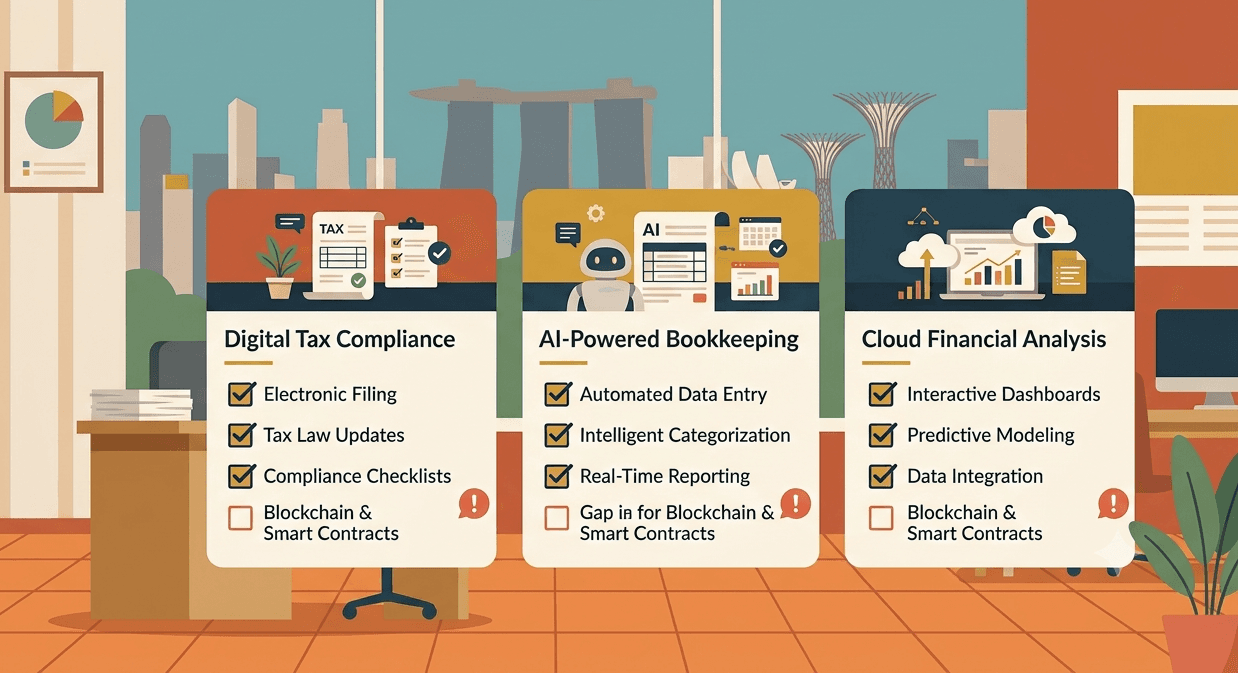
Here's the thing none of the course pages say out loud. Every one of these programmes — the free flagship, the subsidised shelf, the vendor webinars — teaches you AI fluency. How to prompt. How to summarise. How to build a chatbot. How to point a model at some data and get a plausible answer.
None of them teaches you how to automate your firm's actual reporting stack. The messy Xero export. The management pack with your specific layout, your calculated rows, your variance columns. The multi-entity consolidation with intercompany eliminations that has to tie out to the cent. The budget-vs-actual that finance leadership has quietly redesigned four times.
That's not a knock on the courses. AI fluency is a real, valuable skill, and being able to prompt well is table stakes now. But there's a large distance between "I can get ChatGPT to draft an email" and "our monthly board pack builds itself reliably, every month, without someone rebuilding an Excel model that nobody fully trusts." The first is a course. The second is a system — one built around how your firm actually reports, not a generic template.
So the sensible plan for 2026 is: Take the free fluency training (AIxAccountancy if you're an ISCA member; a SkillsFuture course or two if you want something specific), get the badge, build the baseline. Then be clear-eyed that the fluency is the start, not the finish. The workflows that eat your week don't get fixed by a certificate — they get fixed by building the automation, or by working with someone who does.
If your monthly reporting is still a manual grind after every course you've taken, that's the part Cheetah exists to solve — custom reporting built directly on top of Xero, shaped to how your firm actually reports. Worth a look once the fluency box is ticked.
Take the free courses. They're good, they're subsidised (even free in some cases), and the badge is worth having. Just don't expect any of them to know what your board needs to see on page one.

A finance professional turned product builder, Jarvin has built hundreds of reports by hand and knows what financial and operational reporting demands: customisability, auditability, scalability, and security. Having automated that work reliably, he's now helping advisory firms and finance teams do the same.
