GST InvoiceNow on Xero: Your Deadline, the Setup, and What IRAS Will Now See
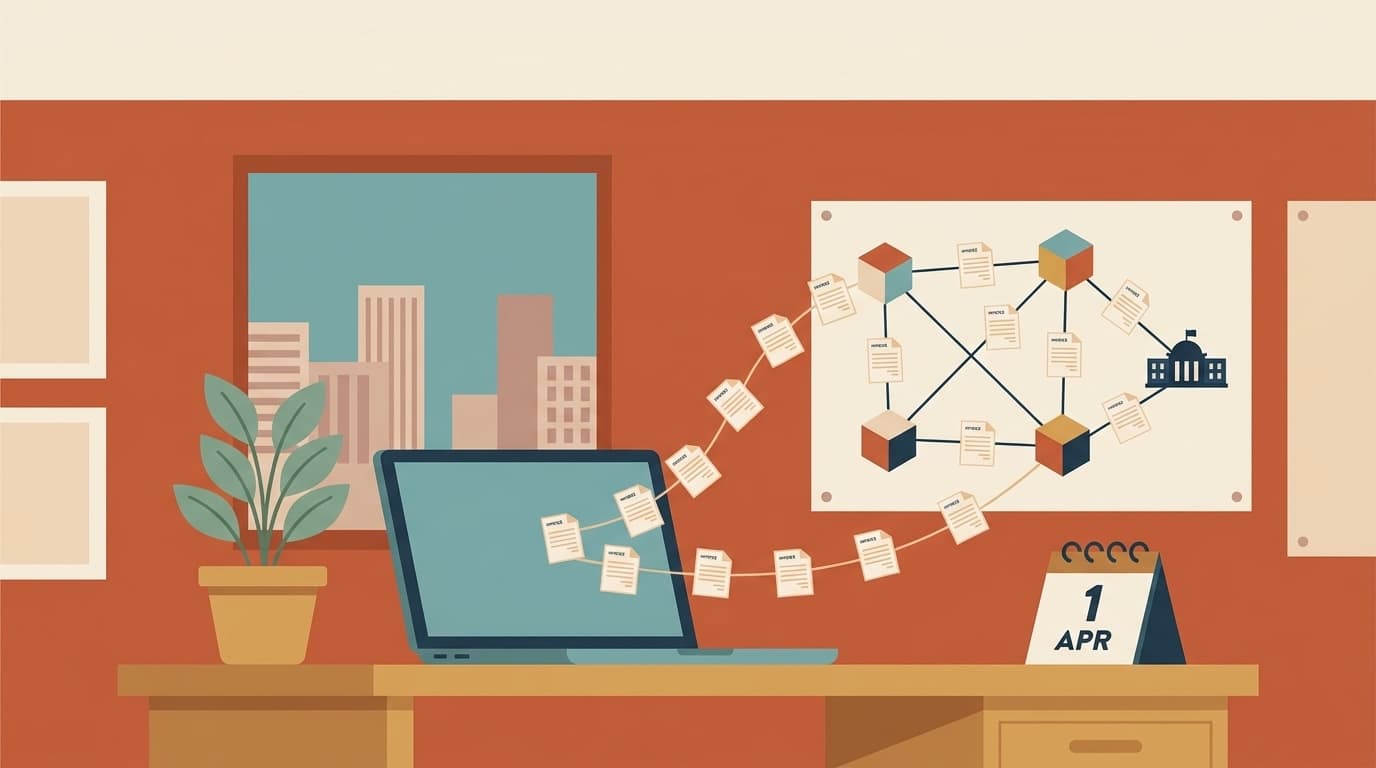
Five corners on the network now, and one of them is the taxman.
Until now, IRAS has seen your GST life four times a year, as nine boxes on an F5. What sat behind those boxes — the invoices, the credit notes, the coding decisions — stayed inside your accounting file unless an auditor came asking.
That arrangement is ending. Under the GST InvoiceNow requirement, GST-registered businesses transmit invoice-level data to IRAS through the InvoiceNow network, invoice by invoice, before the return is even filed. It's already mandatory for new voluntary registrants, and at Committee of Supply 2026, IRAS confirmed the part everyone suspected was coming: by April 2031, it covers every GST-registered business in Singapore.
If your books run on Xero, here's your date, the setup, and the part most of the coverage skips — what it changes about your GST reporting.
Find your date
The rollout is deliberately smallest-first:
| From | Who must comply | Status |
|---|---|---|
| 1 November 2025 | Newly incorporated companies registering voluntarily for GST | In force |
| 1 April 2026 | All new voluntary GST registrants, whatever the incorporation date | In force |
| 1 April 2028 | New compulsory GST registrants, plus existing GST-registered businesses with annual taxable supplies up to S$200,000 | Announced |
| 1 April 2029 | Existing businesses with taxable supplies up to S$1 million | Announced |
| 1 April 2030 | Existing businesses with taxable supplies up to S$4 million | Announced |
| 1 April 2031 | All remaining GST-registered businesses | Announced |
Two readings of that list. If you registered for GST years ago and turn over S$3 million, your date is April 2030 and nothing is urgent. But if you're incorporating and want voluntary GST registration — common for startups reclaiming input tax before revenue arrives — InvoiceNow onboarding is now part of the registration itself. There is no "we'll sort it out later" lane for new registrants.
What IRAS actually receives
InvoiceNow runs on Peppol, and the GST requirement extends the standard four-corner model to five: your invoice still travels from your system through Access Points to your customer, but a structured extract of the data now also goes to IRAS.
Three details worth getting right, because they change how much work this is:
It's not just sales. Purchase invoices recorded in your accounting solution are transmitted too. Your input tax claims become visible at line level, not just as a Box 7 total.
Your customers don't need to be on the network. For B2C sales, or B2B customers who aren't InvoiceNow-registered, you still issue a normal PDF or paper invoice — but the invoice data recorded in your system is transmitted to IRAS anyway. Retail and F&B operators don't Peppol every till receipt, but the recorded data still flows.
There's a deadline per return, not per invoice. Invoice data must reach IRAS by the earlier of the date you file the GST return covering those invoices or that return's due date. In practice: if your solution is set up properly, this happens without you thinking about it. If it isn't, you've invented a new way to be late.
Setting it up in Xero
Xero is InvoiceNow-ready, and the setup is genuinely not painful — but it has a two-step structure that catches people out.
Step one is joining the network. You connect your organisation to Invoici from Xero, Xero's e-invoicing app, which registers you on Peppol and issues your Peppol ID. Your CorpPass administrator authorises the registration. From that point you can send e-invoices to any customer whose Peppol ID you've saved on their Xero contact record, and receive supplier e-invoices straight into your file as draft bills.
Step two is the one that satisfies IRAS: activating GST InvoiceNow submission, a separate switch inside Invoici's settings, with another CorpPass authorisation. This is what turns on the data transmission to IRAS.
The gotcha: plenty of Singapore businesses registered for Peppol years ago, when InvoiceNow was a productivity initiative rather than a tax one. Being on the network is not the same as transmitting to IRAS. If your compliance plan is "we already do e-invoicing," check step two before you rely on it.
The part that isn't about invoicing at all
Here's the honest read: the setup is a morning's work. The real change is what happens after.
Once IRAS receives your invoice data continuously, your GST return stops being the first thing the tax authority sees and becomes the thing it checks against. The F5 you file has to reconcile with the invoice data you've already transmitted — and any gap between them is no longer a private matter between you and your ledger.
Which means the things that were always slightly untidy in Xero files now have an audience:
- Manual journals posted straight to the GST account, which never carry invoice data.
- "No GST" versus "Zero Rated" coding applied inconsistently across the same supplier.
- Credit notes raised months after the invoice they adjust, landing in a different return period.
- Adjustments made in the return itself that never made it back into Xero.
None of these are new problems. What's new is that they'll show up as discrepancies between transmitted data and filed returns, and IRAS gets to notice them before you do.
The teams that will find this transition boring — which is the goal — are the ones that reconcile continuously: an F5-to-ledger reconciliation each period, and an exception report that surfaces uncoded tax rates, GST-touching journals, and out-of-period credit notes while they're still fixable. Xero's standard reports won't give you that view; this is the same category of gap we hit with the schedules a corporate tax filing needs — the data is all in Xero, but the report isn't.
That's the shape of thing Cheetah builds: custom reconciliation and exception reports generated straight from your live Xero data, on a schedule, so the file IRAS sees transaction-by-transaction is one you've already checked. If your GST phase date is on the horizon and your ledger hygiene depends on one person remembering to look, it might be worth a conversation.
The money on the table
Adoption costs are partly covered, for now. Alongside the COS 2026 announcement, the government introduced transitional funding — up to S$1,000 for SMEs and up to S$5,000 for larger businesses — and SMEs can use approved InvoiceNow-Ready Solution packages free until March 2031.
If your date is 2028 or later, there's no need to sprint. But "later" has a habit of arriving during a quarter-end. Find your phase, check whether your Peppol registration actually includes the IRAS transmission, and clean up the GST coding while nobody's watching — because from your phase date onwards, someone is.
Frequently asked questions
- When does the GST InvoiceNow requirement apply to my business?
- It already applies to newly incorporated companies that registered voluntarily for GST from 1 November 2025, and to all new voluntary GST registrants from 1 April 2026. IRAS announced at Committee of Supply 2026 that it extends to everyone else in phases: new compulsory registrants and existing businesses with annual taxable supplies up to S$200,000 from 1 April 2028, up to S$1 million from 1 April 2029, up to S$4 million from 1 April 2030, and all remaining GST-registered businesses by 1 April 2031.
- Does Xero support GST InvoiceNow?
- Yes. Xero connects to the InvoiceNow (Peppol) network through its e-invoicing app, Invoici from Xero, which registers your organisation and issues a Peppol ID with authorisation from your CorpPass administrator. Transmitting invoice data to IRAS is a separate activation on top of the Peppol registration — being on the network alone does not satisfy the GST InvoiceNow requirement.
- What invoice data does IRAS receive under GST InvoiceNow?
- Structured data from your sales invoices and credit notes, plus purchase invoices recorded in your accounting solution, transmitted through your Access Point to IRAS. The data must reach IRAS by the earlier of the date you actually file the GST return covering those invoices or that return's filing due date. Customers who are not on InvoiceNow still get a normal PDF or paper invoice — but the data goes to IRAS regardless.
- Is there funding support for adopting InvoiceNow?
- Yes. Alongside the Committee of Supply 2026 announcement, the government introduced transitional funding of up to S$1,000 for SMEs and up to S$5,000 for larger businesses to offset onboarding costs, and SMEs can use approved InvoiceNow-Ready Solution packages free of charge until March 2031.

A finance professional turned product builder, Jarvin has built hundreds of reports by hand and knows what financial and operational reporting demands: customisability, auditability, scalability, and security. Having automated that work reliably, he's now helping advisory firms and finance teams do the same.
